

Your First Month of Quran Classes — 100% FREE
Live 1-on-1 lessons with a qualified real tutor — on WhatsApp, Zoom or Teams. No card required, cancel anytime.
- Male & female tutors
- Flexible timings worldwide
- Qaida • Tajweed • Hifz
Prefer to talk first? Chat on WhatsApp: +1 872-244-6620
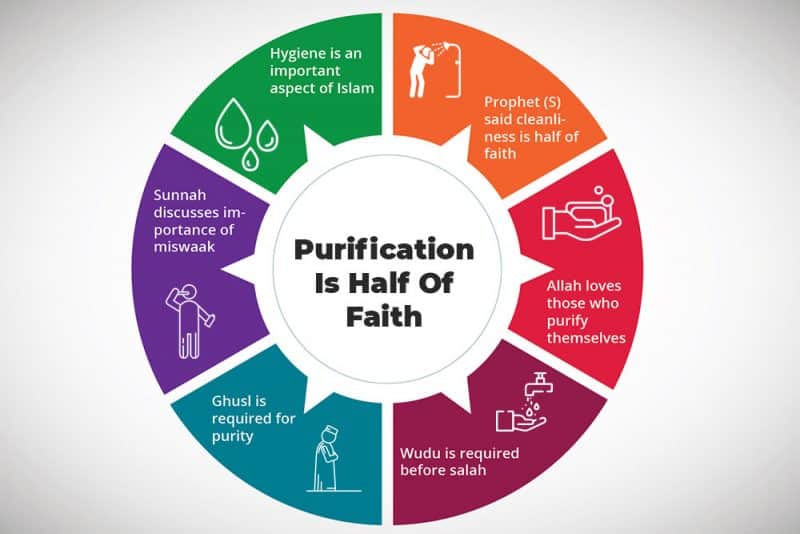
Islam implements its different rules and regulation regarding hygiene. It does not only give rules to hygiene but in order to implement it through every aspect, it makes these rules part of the faith. In simple words, it provides enough importance to purification and makes the believers compel to implement the given rule in their life.
Prophet Muhammad SAW said’ Cleanliness (Purification) is half of faith.) There are different others Ahadith who confirmed Ahadith to verify the status of cleanliness.
Quaran becomes evident in order to maintain the given principles of cleanliness and lays emphasis to meet the essential principle of cleanliness.
Allah says,” Honestly, God Loves people who get back to him in repentance and have a love for those who clean (purify) themselves.) (Quaran 2.222)
The importance of cleanliness quickly becomes obvious via these Ayah and Ahadith. Even, the acceptance of prayers, dua, and Dhikr is strictly attributed to the cleansing and purification.
It also does not only emphasize the physical cleanliness, but it also guides us to inner-purification cleanliness has two kinds. First is inner purification, and the second is Outer purification.
Holy Prophet SAW as an example
The Holy Prophet Muhammad (peace be upon him) demonstrated the importance of cleanliness not just through words, but through his own actions. He showed Muslims how to implement Allah’s commands for Salah, Hajj, and other rituals. For instance, he practiced cleanliness by performing Wudu, using Miswak, taking regular baths, and washing his hands. He stated, “Cleanliness is the key to prayer, Takbir is its beginning, and Salam is its end” (Abu Dawood).
Cleanliness, both physical and spiritual, holds immense significance in Islam. It is directly linked to faith, which combines obedience and acknowledgment of Allah’s authority. This profound reward underscores the vital role of cleanliness in Islamic life.
Learn Quran From Home — Free for a Whole Month
One-to-one sessions with certified tutors, on the app you already use. Try it free, no obligation.
- 👨🏫 Certified 1-on-1 tutors
- 💬 WhatsApp · Zoom · Teams
- 📖 All ages & levels
Prefer to talk first? Chat on WhatsApp: +1 872-244-6620
The importance of cleanliness by Ahadith
Cleanliness is essential in Islam, as highlighted by the Hadith narrated by Abu-Malik Al-Ahsri: “Purification is half of faith.” The Hadith emphasizes that cleanliness is not only about physical appearance but also spiritual purity. Islam requires both internal and external cleanliness for rituals.
Prophet Muhammad (peace be upon him) stressed the importance of maintaining clean clothes. When he saw a man with dirty attire, he remarked on the need for cleanliness. This shows that Islam values clean clothes over their newness or quality.
The Prophet also encouraged taking a bath on Fridays and using perfume, reflecting Islam’s emphasis on personal hygiene. According to another Hadith by Abu Hurayrah, Muslims should bathe weekly to maintain cleanliness.
Islam mandates Wudu (ablution) before prayers and handling the Quran, reinforcing the importance of physical purity. A Hadith warns against attending the mosque after eating garlic or onions due to their strong odor, which can disturb others.
Aisha (may Allah be pleased with her) mentioned that she often perfumed the Prophet, demonstrating the significance of personal grooming.
In summary, Islam upholds both physical and spiritual cleanliness as crucial elements of worship. Cleanliness, as detailed in various Hadith, is integral to faith and religious practice.
Religious Ritual Washing
There are different Hadith on cleanliness that has been written above. Ghusal and Wudhu are essential enough for worship in Islam.
Wudhu
Wudhu is necessary to offer the prayer, and it is also mandatory to recite the Quaran by holding it in hands. It means that wudhu and cleanliness both have co-relation.
It does not fulfill our responsibility imposed by Islam, but it also saves us from different diseases due to removing germs, viruses, and bacteria, As the Coronavirus is spreading fast in the world. The experts say that washing hands and mouth can save us from this deadly disease. It is all included in The Wudhu.
Ghusal
Ghusal is crucial for performing religious practices in Islam. Without proper cleanliness, rituals cannot be carried out. For Janaba, you must perform Ghusal before engaging in religious activities. Islam outlines methods for both Wudu and Ghusal, with practical guidance from the Prophet Muhammad (PBUH) and his companions. The Prophet (PBUH) emphasized the significance of cleanliness, stating, “Purification is half of Iman.”
Start Online Quran Lessons — Your First Month Is 100% Free 🎁
Book your free 1-on-1 online Quran classes — Qaida, Tajweed & Hifz with a qualified tutor on WhatsApp, Zoom or Teams. Limited slots this week — start within 24 hours.
Prefer to talk first? Chat on WhatsApp: +1 872-244-6620
